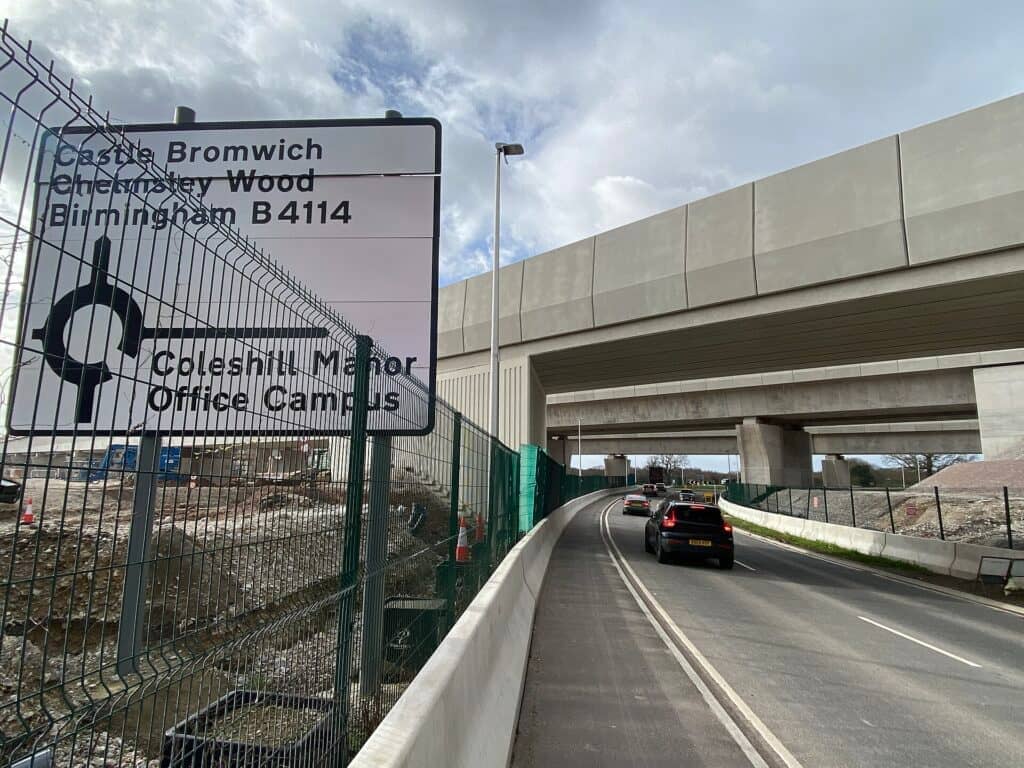
Over a single weekend closure of the M42 near Birmingham, HS2's main works contractor Balfour Beatty VINCI (BBV) lifted two 1,000-tonne viaduct spans into place at Water Orton and installed the final 44 beams on a 300-metre box structure that carries the new railway over the motorway. The M42 reopened early on Monday 21 September 2026, around an hour ahead of schedule, marking one of the biggest bridge-building milestones yet on the West Midlands section of Britain's new high-speed line.
Two 1,000-tonne spans for Water Orton Viaduct 2
The two new spans complete Viaduct 2 at Water Orton. Each is 45 metres long and weighs around 1,000 tonnes, and each was built from 18 precast concrete segments. The segments were cast using concrete from a local batching plant at Kingsbury, then joined and stressed together with tensioning cables before self-propelled modular transporters (SPMTs) moved the finished spans into position.
The Water Orton viaducts are among the most complex structures on this stretch of HS2, carrying the line over the M42, the A446, the Birmingham to Peterborough railway and the River Tame. A team of 75 people worked on the span installation. Precast segmental construction like this is a core skill in modern civil engineering, as it moves most of the work away from live roads and railways.

Finishing the M42 twin box structure
Alongside the viaduct, a 150-strong team placed the final 44 beams on the M42 twin box structure. At 300 metres long and 10 metres high, the structure has two 145-metre walls and 46 internal columns. Its roof is made up of 175 precast beams, each 23 metres long and weighing between 56 and 92 tonnes, which together weigh about 9,800 tonnes.
A 300-tonne crawler crane lifted the beams into place. The structures were designed by Mott MacDonald, SYSTRA and WW+P Architects for BBV.
Why weekend closures shape the engineering
Closing a major motorway is expensive and disruptive, so every hour counts. Building the viaduct spans and roof beams off-site meant the weekend could be used almost entirely for lifting and fixing rather than construction. BBV project director Oliver Shore said the team had now completed bridging works on three major structures crossing the M42 in four weekends, while HS2 senior project manager Agnes Usciak credited the engineers with the precision that allowed the motorway to reopen on time.
The approach shows how heavy-lift planning, temporary works design and precast manufacturing now drive programmes on large UK infrastructure schemes.
What happens next, and what it means for engineers